
Golden Beach foreshore works
Find out about works along the Golden Beach foreshore including TS Onslow and Diamond Head.
Work to protect the Golden Beach foreshore is underway as part of the Bribie Island breakthrough action plan. It includes upgrading seawalls, building new beach accesses, raising sections of the coastal pathway and other foreshore works.
The work in this area is being delivered in sections as funding and grants allow (see map below).
Completed
- Seawall renewal - Jellicoe and Nelson Streets, Golden Beach
- Seawall renewal – TS Onslow to Nelson Street, Golden Beach
- Renewal of rock groynes at Oxley Street, Leichardt Street, Wills Avenue and Jellicoe Street
- Temporary pathway and parkland works at Diamond Head - due to Bribie Island breakthroughs 2 and 3
Underway
- Diamond Head seawall and parkland design - Lamerough Canal to the June Street boat ramp
- Minor foreshore sand nourishment with a dredge

Community updates
We are committed to updating our community about the Golden Beach foreshore works.
Read through the latest Community Updates below.
Community Updates
Community Updates
- Community Update - 9 June 2026 - TS Onslow seawall complete + Diamond Head seawall update
- Community Update - 24 April 2026 - TS Onslow seawall nearing completion
- Community Update - TS Onslow staged completion and Christmas construction pause - 15 December 2025
- Community Update - TS Onslow early morning equipment removal - 14 November 2025
- Community Update - TS Onslow concrete pour - 10 September 2025
- Community Update - Golden Beach foreshore works - 11 August 2025
- Community Update (printable) - Golden Beach foreshore works - 11 August 2025
- Community Update - TS Onslow - 4 August 2025
- Community Update - Golden Beach foreshore works - 21 July 2025
- Community Update - TS Onslow - 17 July 2025
- Community Update (printable) - Golden Beach foreshore works update - 17 July 2025
- Community Update - TS Onslow - 17 July 2025
- Community Update - Golden Beach foreshore temporary works - 25 June 2025
- Community Update - Revetment wall repairs at Lamerough Canal entrance, Pelican Waters - 20 June 2025
- Community Update - TS Onslow seawall works underway - 18 June 2025
- Community Update - How we're working to protect the Golden Beach foreshore - 21 May 2025
- Community Update - Esplanade seawall and foreshore works completed - 17 December 2024
Diamond Head seawall and parkland design
We’re working hard to protect and preserve the beautiful foreshore along Diamond Head at Golden Beach – so it keeps the character and values our community loves.
Have your say - Phase 2 engagement: Keith Hill Park
Thanks to the valuable input from our community during Phase 1 engagement late 2025, we prepared a draft concept design for the Diamond Head foreshore at Keith Hill Park.
We then checked that the design reflects what you told us and gave you a chance to help fine tune the plan before we finalise it, in Phase 2 engagement. You can read about the engagement on the Have your Say Sunshine Coast website.
Your feedback will help shape the final design.
Park upgrades will follow seawall construction, subject to funding approval.
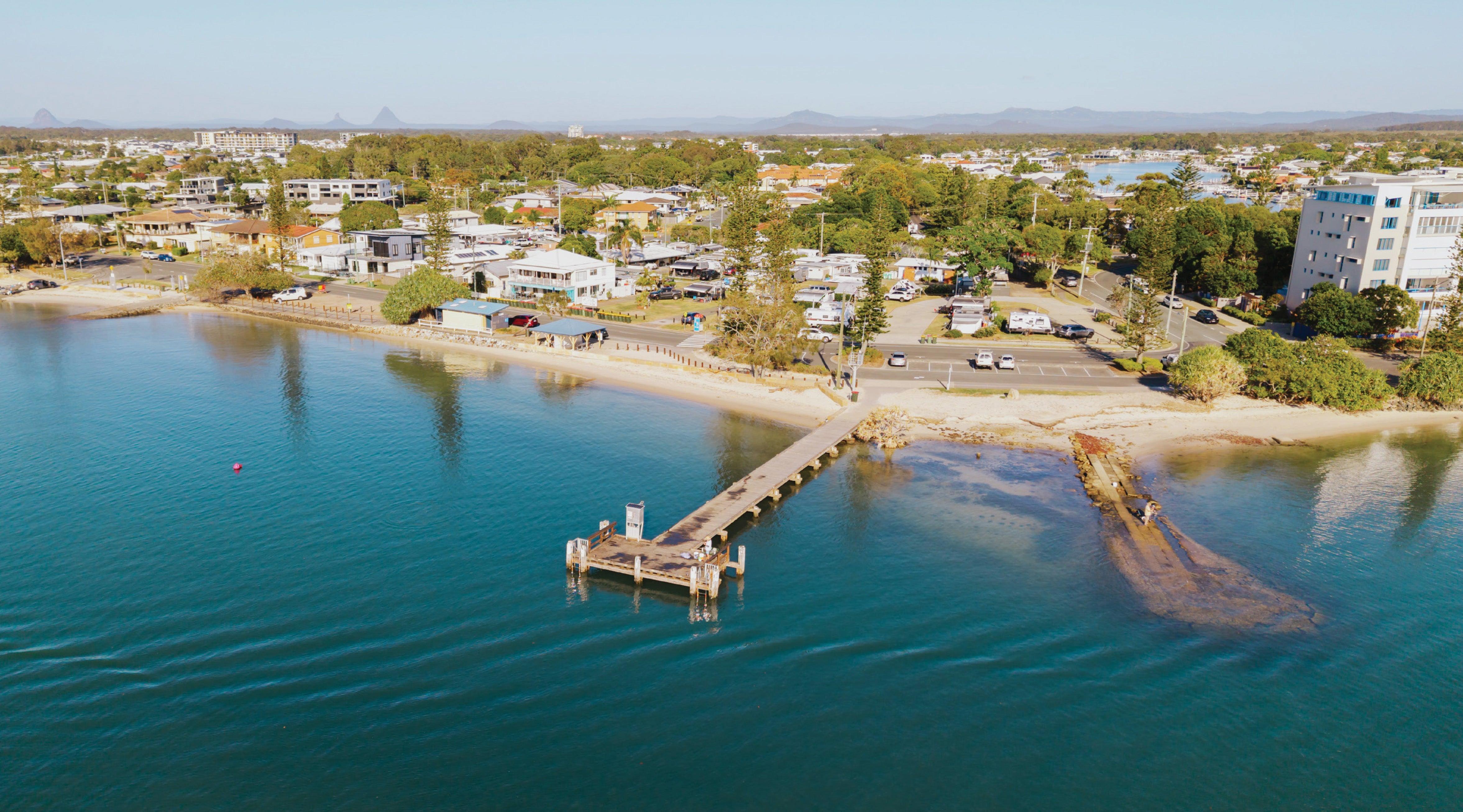
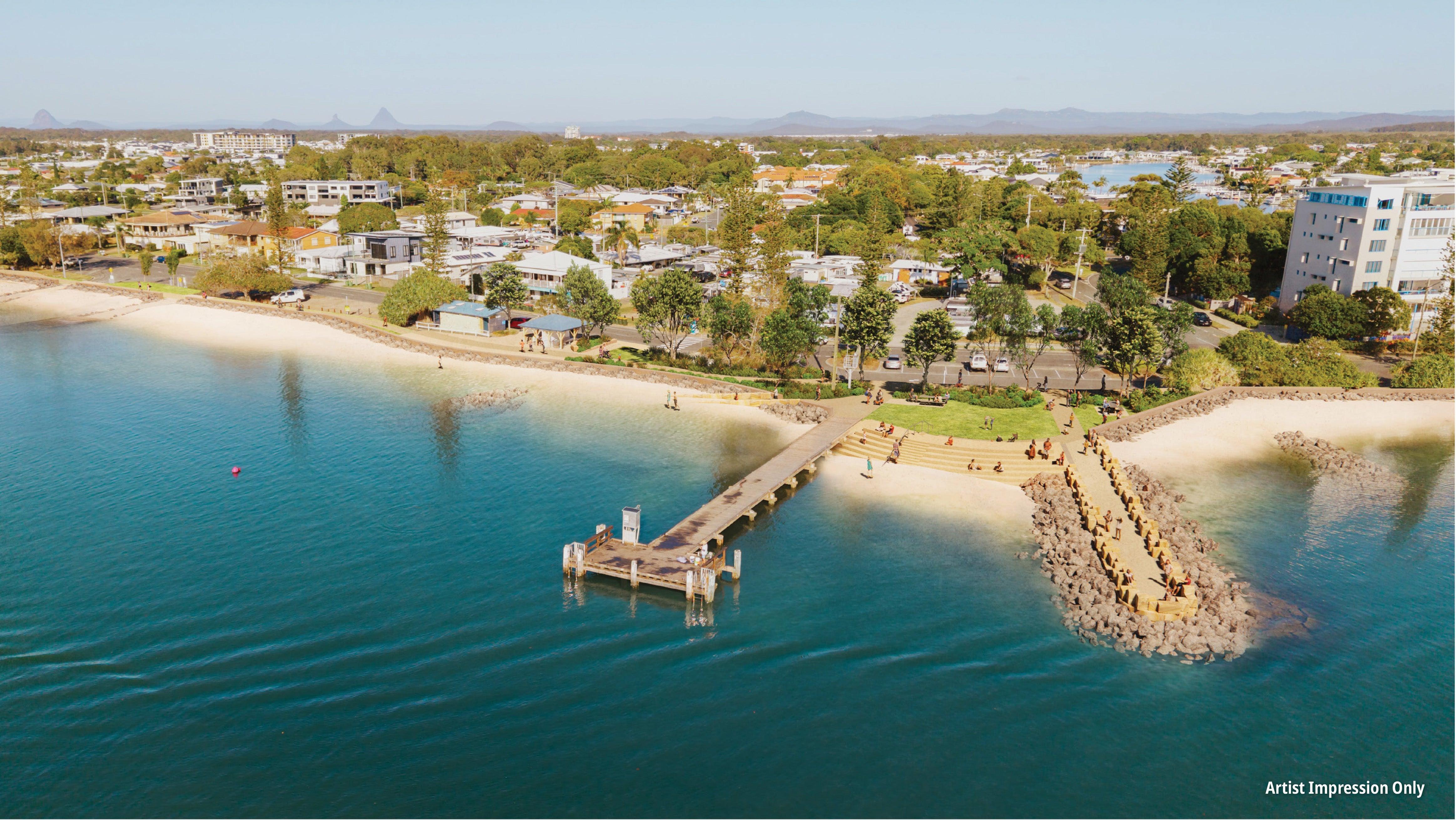
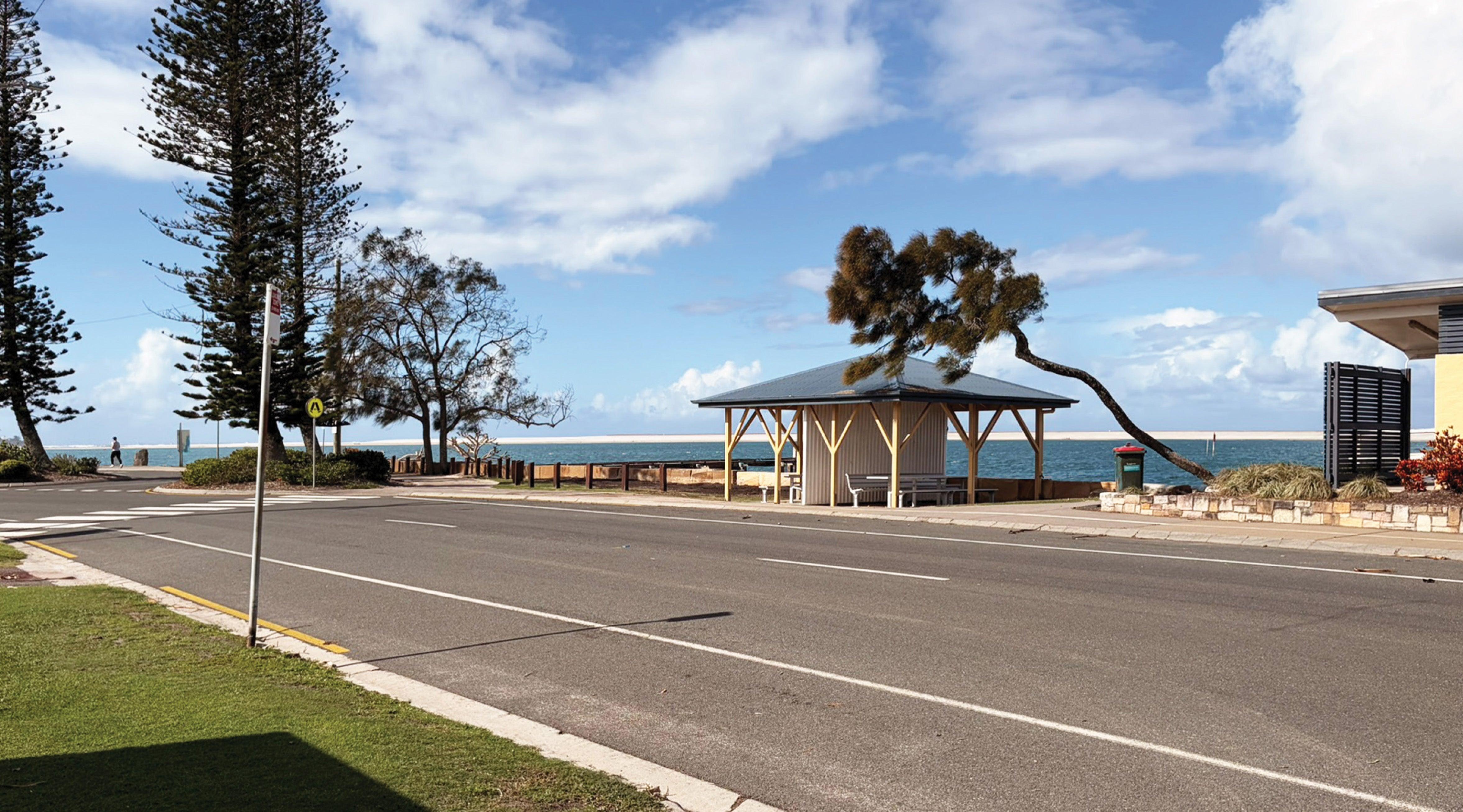
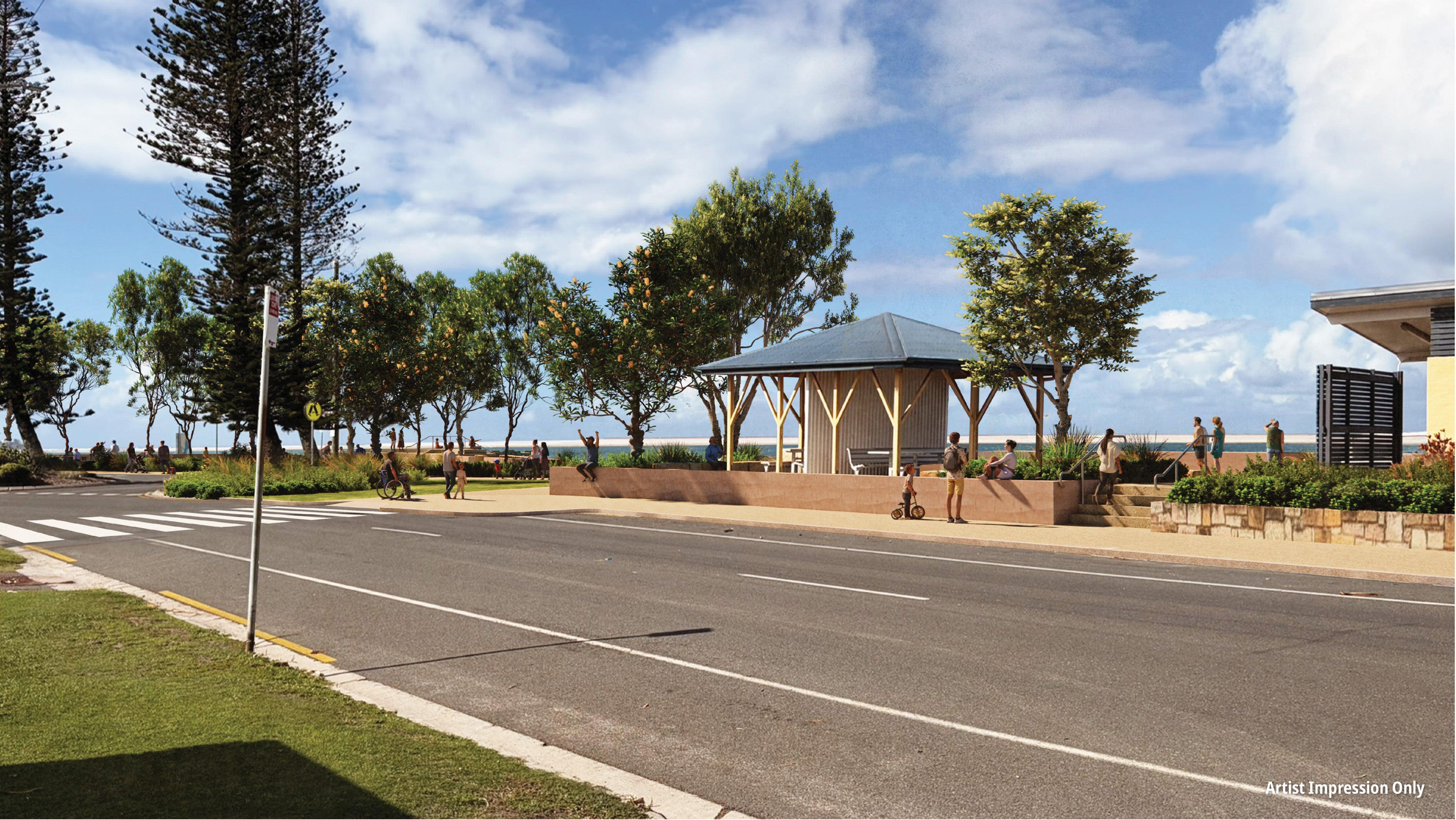
Scroll right to see the before and after images (artist impressions) of proposed foreshore upgrades.
Seawall construction and foreshore works
Seawall construction and foreshore works
Severe storm seasons from 2022 - 2025 have caused rapid changes to Bribie Island and we must act to plan the protection of this well-loved space.
The new seawall from Lamerough Canal to the June Street boat ramp is being designed to be adaptable for future conditions like storm surges, high tides, sea level rise and erosion linked to the Bribie Island breakthrough* and predicted climate changes.
The project also aims to upgrade the stormwater outlets to reduce flooding, renew parts of the coastal pathway, move benches and tables to less vulnerable positions, barbecues, park shade trees, shelters, and linking pathways, to more suitable locations.
We expect construction of Stage 1 (from Lamerough Canal to the Military jetty boat ramps) to start around mid to late 2026, depending on procurement and weather conditions.
*It's important to note that the Queensland Government manages Bribie Island.
Why doesn't the proposed seawall alignment protect Keith Hill Park?
Why doesn't the proposed seawall alignment protect Keith Hill Park?
Why doesn’t the proposed seawall alignment protect Keith Hill Park?
The proposed seawall alignment does not include Keith Hill Park because it follows an alignment that has already been approved under State Government coastal planning requirements.
Advice provided to Council during the original approval process in 2016, and again through the recent amendment process, indicated that a seawall located along the existing foreshore would be unlikely to receive State approval. As a result, the approved alignment is located further inland and does not extend around Keith Hill Park.
Why is the seawall aligned behind Keith Hill Park instead of along the existing shoreline?
The alignment has been largely shaped by State Government legislative and coastal policy requirements.
During previous approval processes, the State advised that a seawall built along the current shoreline would not be consistent with coastal policy and would therefore be unlikely to gain approval. To meet these requirements, the approved design retains a landward alignment behind Keith Hill Park.
Why can’t Council move the seawall closer to the water to protect the park?
Moving the seawall to the existing shoreline would require Council to apply for a new tidal works approval.
Based on previous advice from the State Government and Council’s own assessment, there is a low likelihood that a new approval for a shoreline alignment would be granted under current coastal policy settings.
Why is the State Government unlikely to support a shoreline alignment?
State coastal policy generally supports coastal protection works where there is significant public infrastructure facing an immediate risk from coastal hazards.
In this location, there is limited public infrastructure. The main asset is the shared pathway, which will be located behind the proposed seawall. As a result, the State’s preference has been to allow natural coastal processes to continue along this section of coastline.
Does the history of the peninsula affect how the proposal is assessed?
Historical aerial photographs suggest the peninsula was created or significantly modified during the early 1980s. Council has not identified records showing State or Council approvals for those works.
This historical context may be a factor considered when assessing any future proposals for coastal protection in the area.
Could the seawall alignment change in the future?
Potentially. If coastal conditions change, or if State coastal policy changes before construction occurs, Council may revisit the alignment with the State Government. This could include exploring whether an alternative alignment can be considered and approved.
Why isn’t the seawall alignment part of community consultation?
The recent consultation was focused on the open space design behind the approved seawall.
The seawall alignment itself reflects an existing approval that has already been assessed through previous planning and approval processes. The alignment is not being reconsidered as part of the current engagement process.
Keith Hill Park (Diamond Head foreshore)
Keith Hill Park (Diamond Head foreshore)
Thanks to the valuable input from our community, we prepared a draft concept design for the Diamond Head foreshore at Keith Hill Park.
Phase 2 engagement (8 June - 3 July 2026) checked that the design reflected what you told us and gave you a chance to help fine tune the plan before we finalise it.
We invited you to review the draft concept design and share your feedback via the Have your Say Sunshine Coast website.
Your feedback will help shape the final design.
Park upgrades will follow seawall construction, subject to funding approval.
About the project
As part of the Bribie Island Breakthrough Action Plan, Council is upgrading the Golden Beach foreshore between Lamerough Canal and the June Street boat ramp.
These works will help protect the coastline from storm surge, high tides and erosion. They will also improve how people use and enjoy this much loved area.
The project will roll out in stages as funding becomes available. Section 1 will focus on the area from Lamerough Canal to the Military Jetty boat ramps.
Key works include:
- A new seawall with upgraded stormwater infrastructure
- Sand renourishment to support a healthier beach
- Improved beach access, including new stairs and a multi-use ramp
Park improvements
Behind the seawall, we are planning upgrades to the park area to make it more usable and resilient.
These include:
- A realigned coastal pathway with improved accessibility
- Relocated and raised seating, shelters and picnic areas to reduce future flood and storm impacts
- New tree planting to restore shade lost in recent shoreline erosion
Together, these upgrades will create a foreshore that is safe, welcoming and built for the future.
What you told us
During Phase 1 engagement, the community shared clear ideas on how Keith Hill Park could better support everyday use.
You told us you want:
- A wider, better aligned coastal pathway
- Easier and more convenient beach access
- Well placed seating and shelters
- More shade and protection of existing trees
- Better protection from future coastal hazards
Your feedback shaped the draft concept design we are now sharing.
Community values guiding the design
The design reflects local feedback and broader community values identified across Golden Beach and Caloundra.
These values include:
- Supporting health and wellbeing
- Protecting and celebrating the natural environment
- Encouraging social connection
- Creating spaces to enjoy the coast
We have balanced these values with technical and environmental requirements to guide the future of the foreshore.
Community engagement
Community engagement
In November and December 2025, we invited our community to review the artist impressions for the foreshore improvements behind the new Diamond Head seawall and share what you think.
Your input helped shape the design, with changes that matter to the community – including more staircases and access ramps. We’ve also looked for ways to reduce the visual impact of the seawall, so it fits more naturally into the landscape.
Thanks to the valuable input from our community, we have prepared a draft concept design for the Diamond Head foreshore at Keith Hill Park. This stage checks that the design reflects what you told us and gives you a chance to help fine tune the plan before we finalise it.
Phase 2 engagement
We invited you to review the draft concept design and share your feedback from 8 June to 3 July 2026.
Our community was able to view the draft concept design, complete a short online survey, tell us what works well and what we should consider, and meet us in the park on 17 June 2026 to discuss the project.
Have your Say Sunshine Coast website.
Your feedback will help shape the final design.
Park upgrades will follow seawall construction, subject to funding approval.
Why this project is needed
Why this project is needed
Council identified key areas requiring intervention through the Bribie Island Breakthrough report (BIB). The endorsed Coastal Hazard Adaptation Strategy (CHAS) and the latest Shoreline Erosion Management Plan (SEMP) have also recommended multiple actions to be undertaken along the entire Golden Beach Foreshore over the next 5-75 years.
We’ve also developed long-term adaptation options as part of the Coastal Hazard Adaptation Precinct Planning (CHAPP) to reduce the risk of coastal hazards and flooding from Bulcock Beach to Bells Creek.
Funding
Funding
The Diamond Head seawall received funding through Round 4 of the QCoast2100 program.
This is delivered in partnership with LGAQ and is jointly funded by the Australian and Queensland Governments under efficiencies realised through the Disaster Recovery Funding Arrangements (DRFA), aimed at supporting priority disaster resilience and mitigation projects across Queensland.
The seawall will be delivered in sections as funding permits. Section 1 is planned from Lamerough Canal to Military Jetty boat ramps to be completed by the end of 2027.
We’re continuing to seek further funding to be able to construct the entire wall, through State and Federal Government recovery and resilience grant opportunities as we were unsuccessful with our funding request through the Coastline Recovery Package associated with TC Alfred.
Timeline
Timeline
- Design and permits: Mid-2026
- Construction (Stage 1 - from Lamerough Canal to the Military jetty boat ramps) scheduled to begin: mid to late 2026, depending on procurement and weather conditions
Seawall renewal: TS Onslow to Nelson Street, Golden Beach
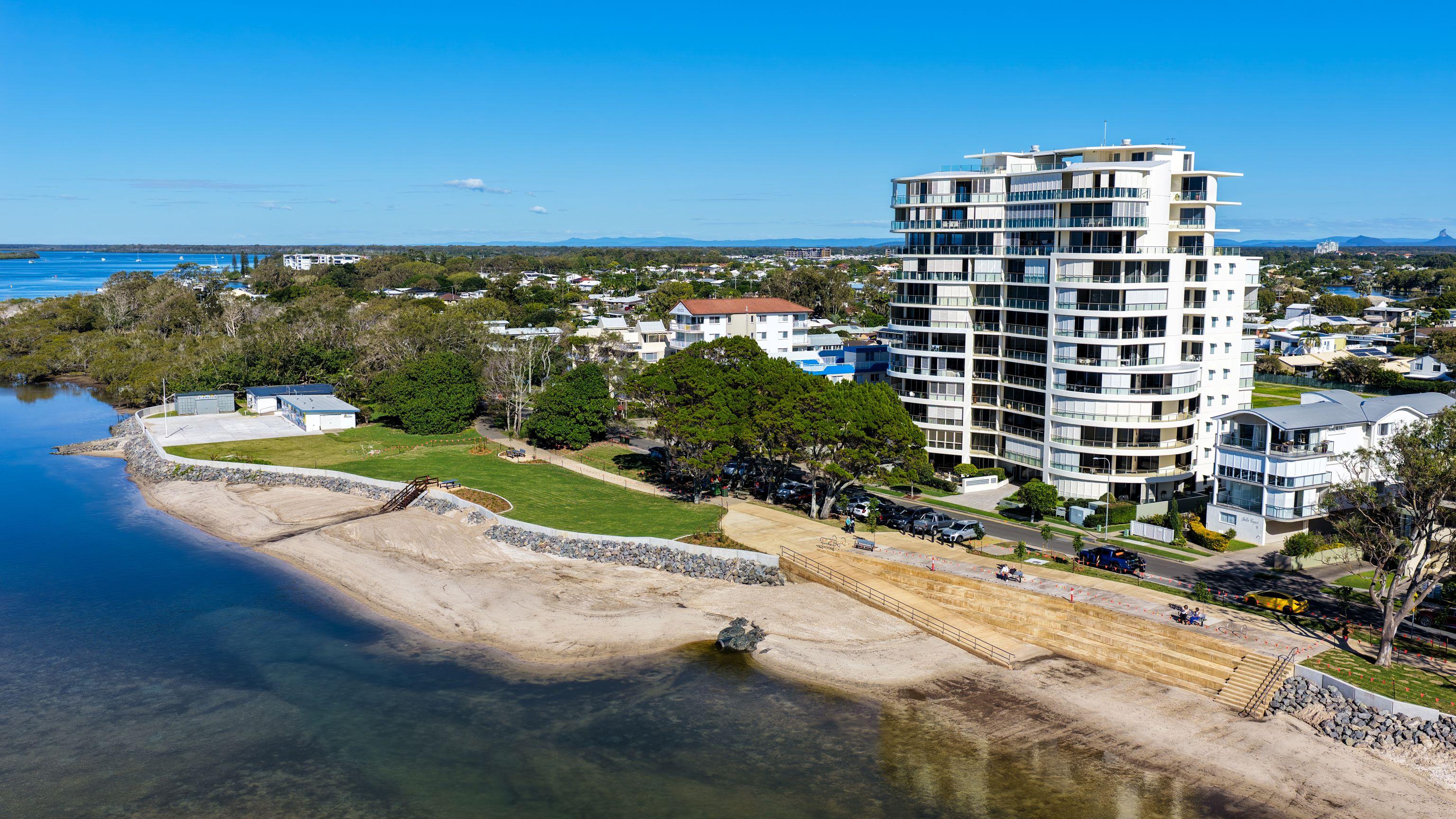
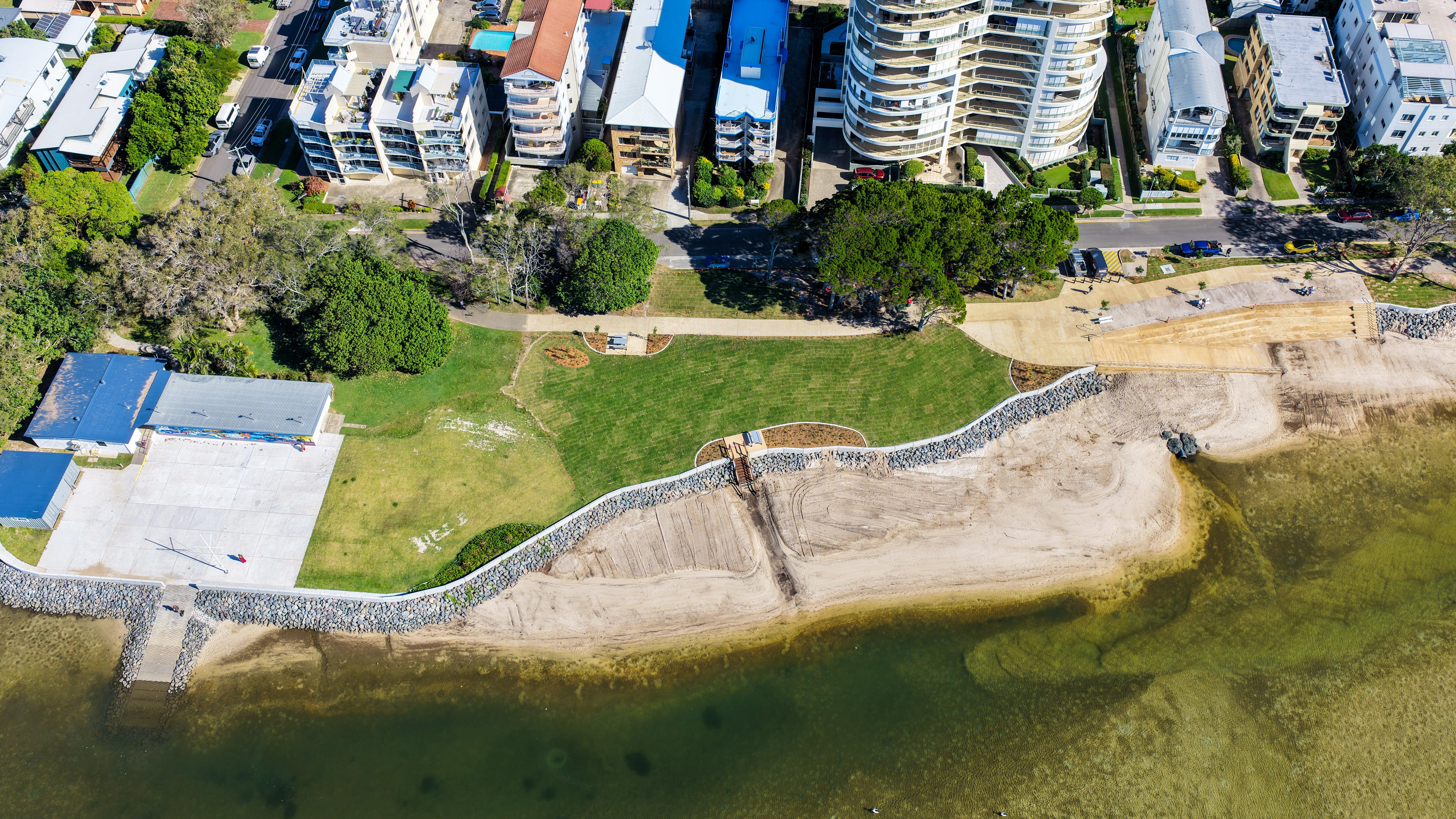
Sunshine Coast Council, in partnership with the Australian and Queensland Governments through the Disaster Funding Recovery Arrangements with funding of $6.3 million has reconstructed the seawall from Nelson Street to the TS Onslow Naval Cadets site.
This vital project strengthens one of Golden Beach’s most loved foreshore areas, delivering greater protection from coastal hazards and more ways for locals and visitors to enjoy the water safely.
This area was significantly impacted by the extraordinary weather events of 2021–2022 and the widening Bribie Island breakthrough.
The upgraded coastal protection works and improved access features are part of Council’s ongoing, strategic approach to safeguarding Golden Beach in the face of a changing environment.
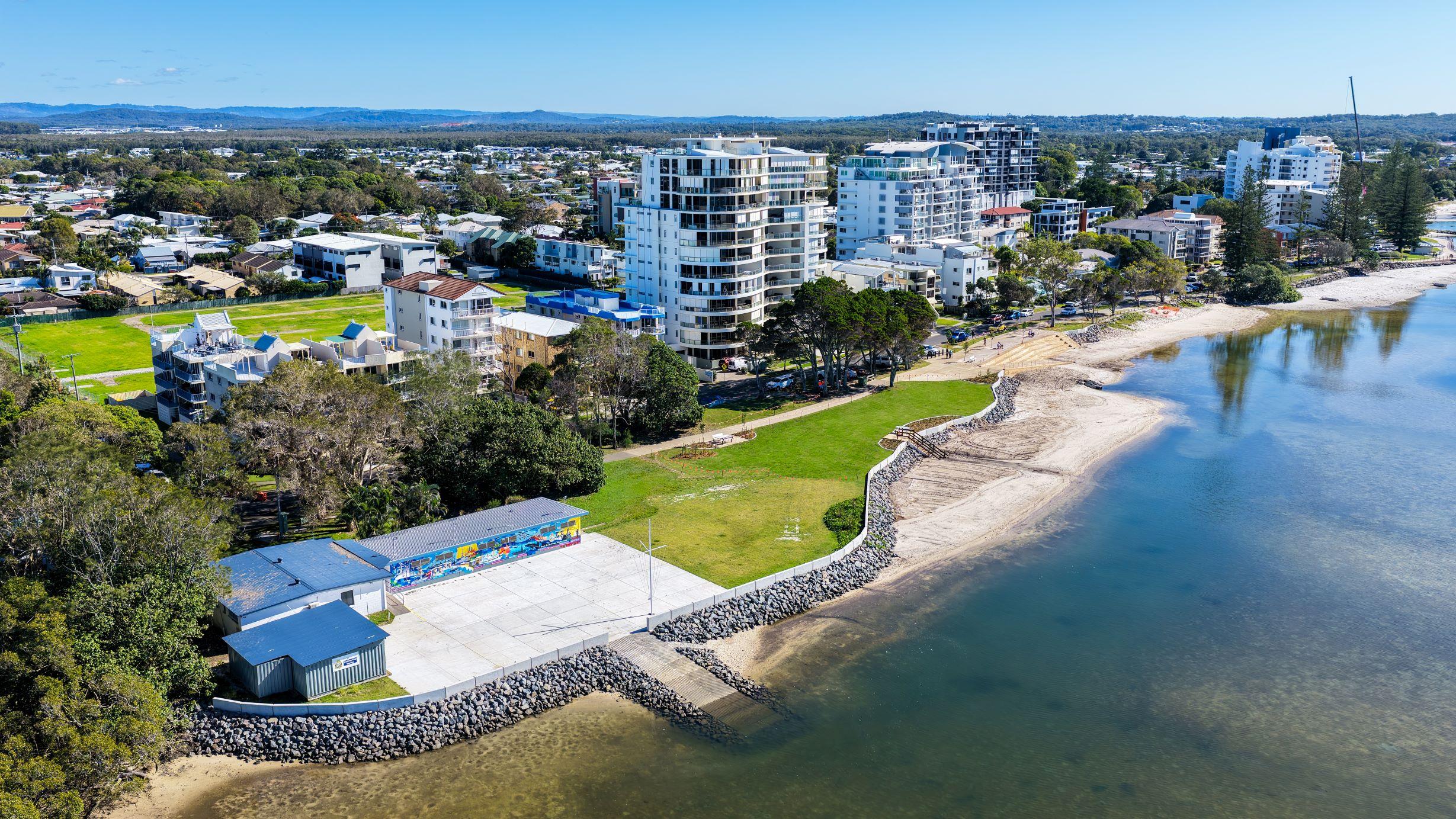
Foreshore works and seawall construction
Foreshore works and seawall construction
We’re building a stronger, smarter coastline at Golden Beach.
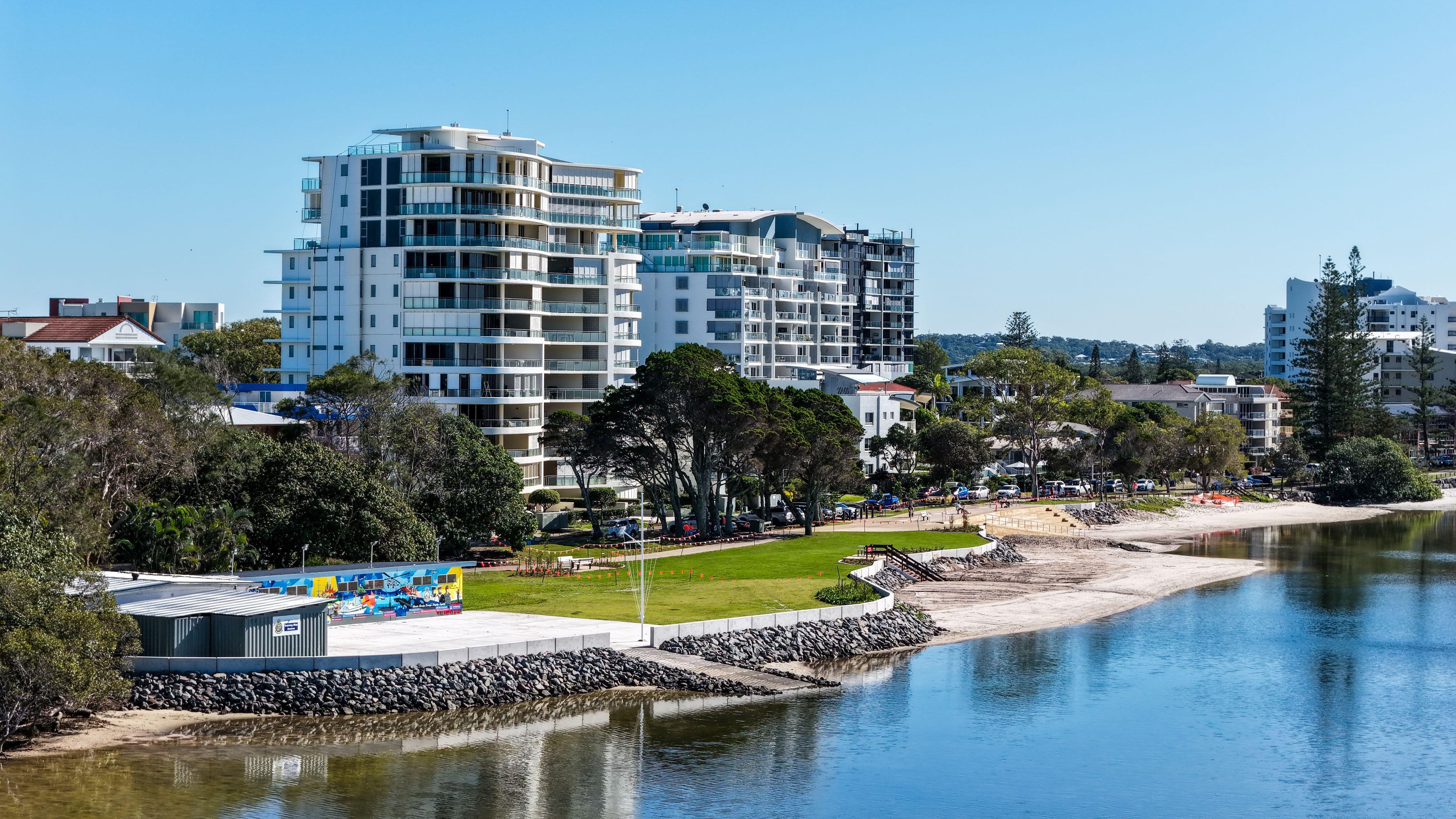
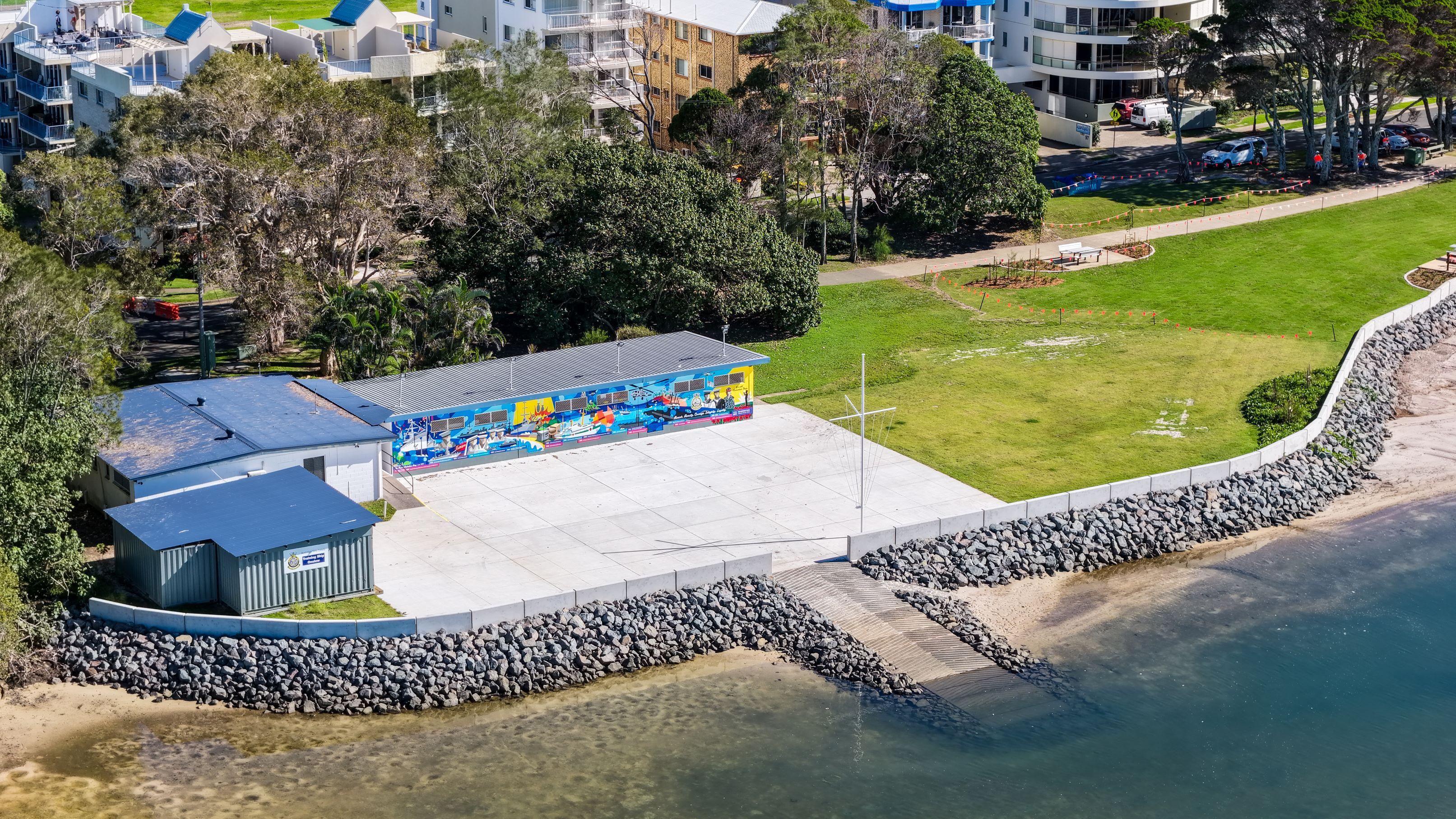
Works are now complete, working with the Australian and Queensland governments, rebuilding the seawall to protect the foreshore from Nelson Street to the TS Onslow Naval Cadets site in southern Golden Beach.
The project will improve access to the beach and water, and reduce coastal impacts to the park area around the TS Onslow Naval Cadets.
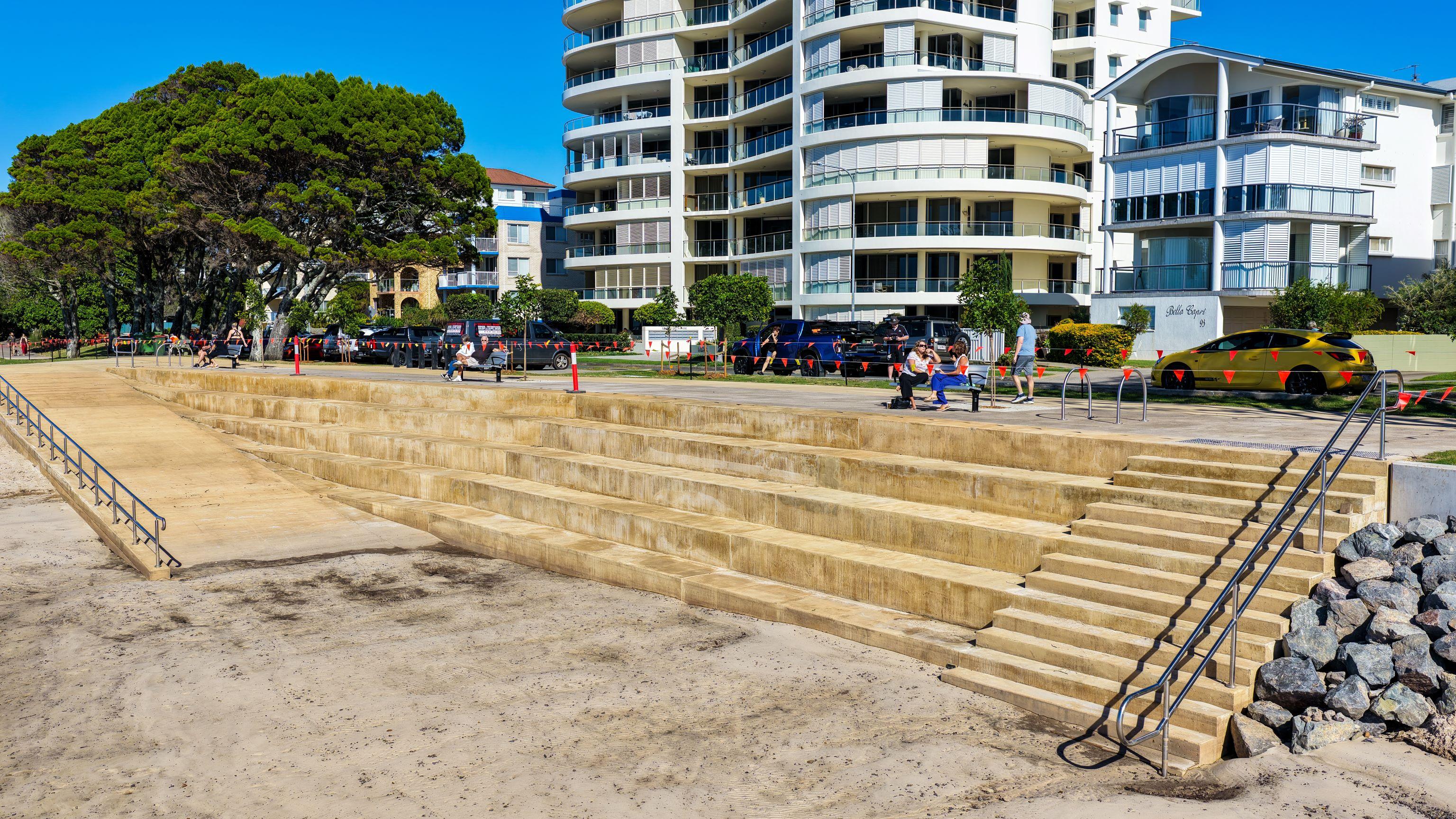
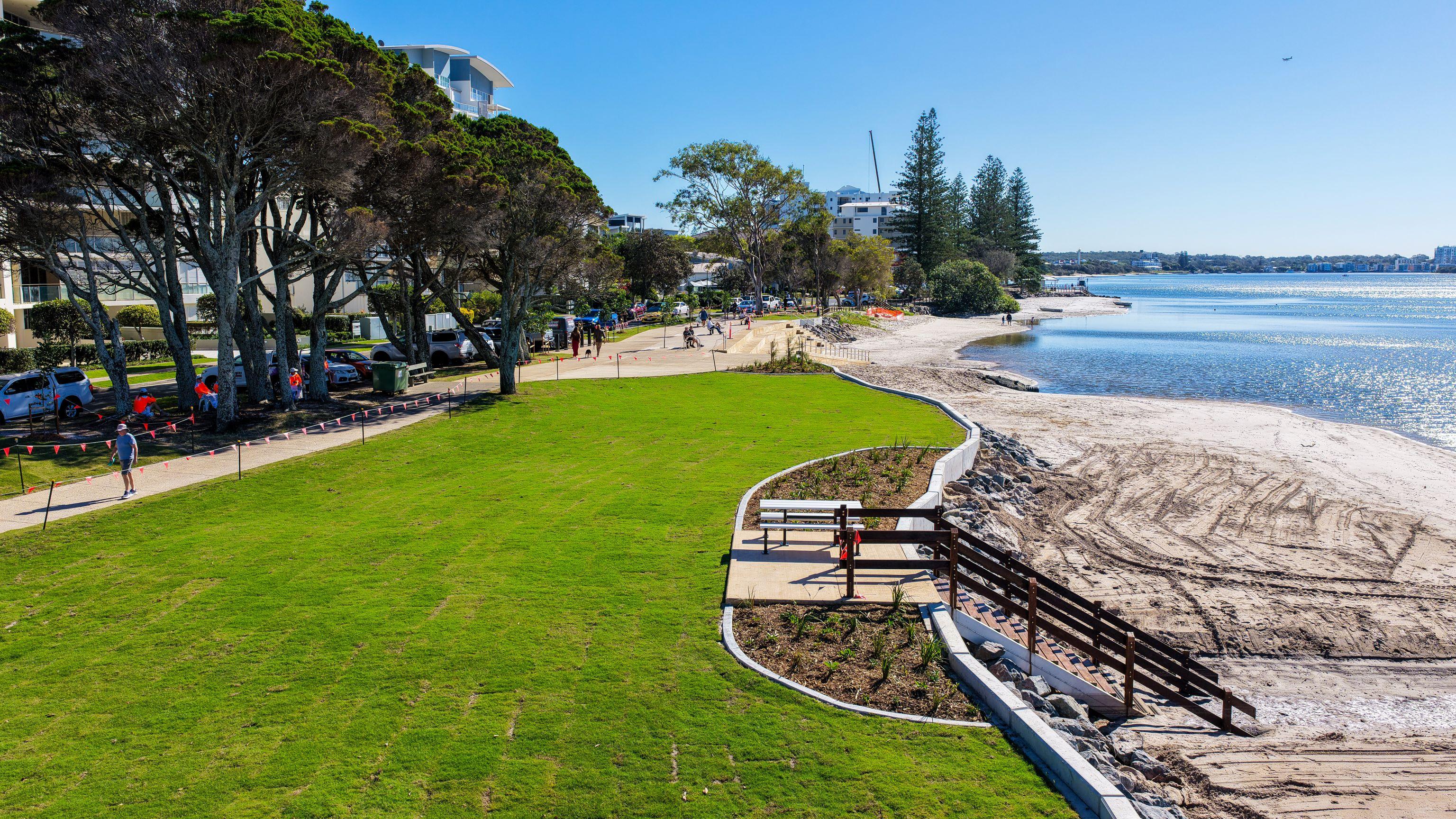
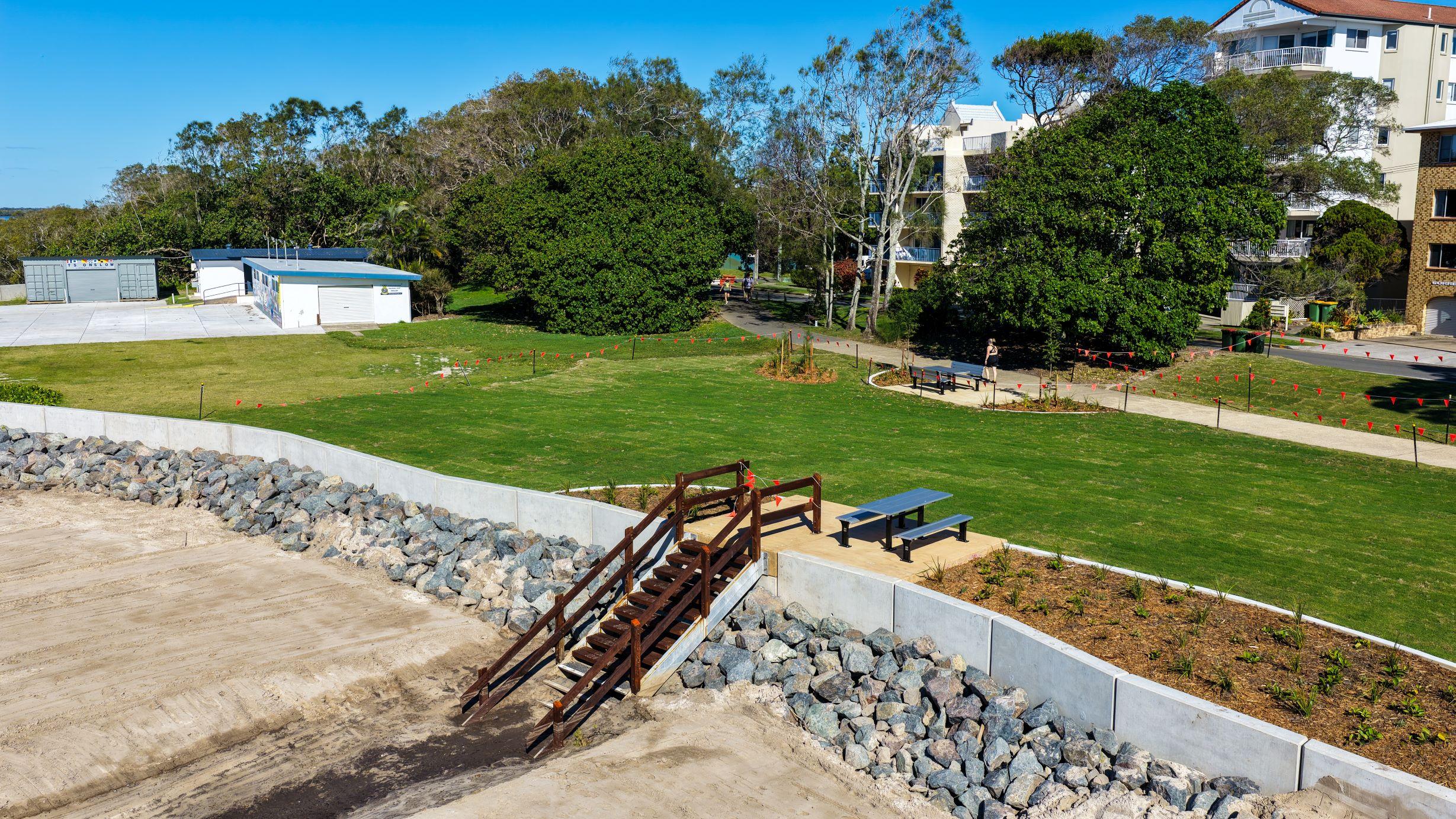
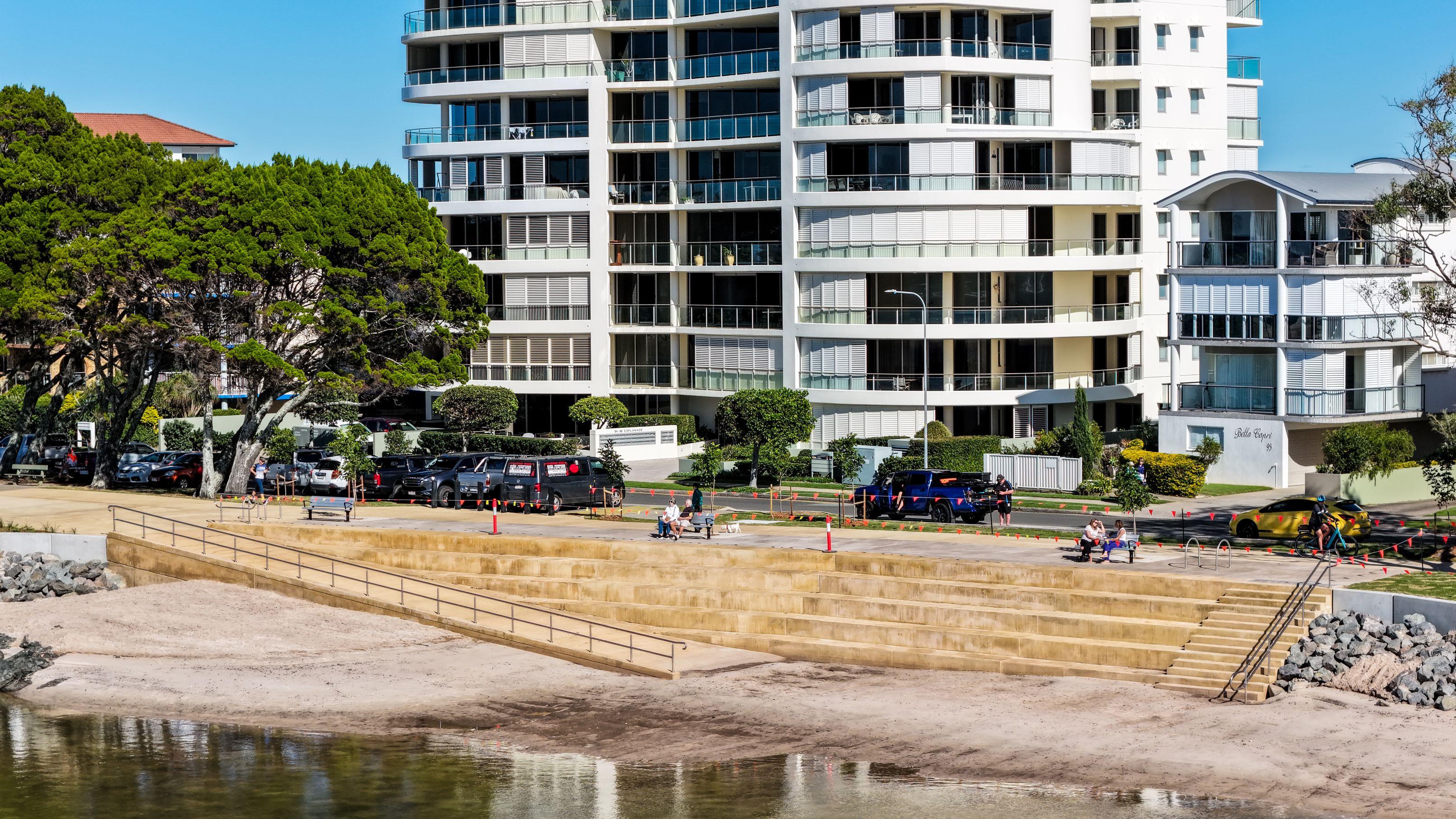
Works included building a 208-metre-long rock seawall and concrete stepped wall, constructing two staircases and integrated beach access ramp with added landscaping.
Funding and TS Onslow site
Funding and TS Onslow site
The TS Onslow site is owned by the Queensland Government and leased by the Navy Cadets.
Sunshine Coast Council led the project team and worked closely with both parties to deliver this important reconstruction.
Sunshine Coast Council acknowledges the funding allocation being jointly funded by the Australian and Queensland Governments under the Disaster Recovery Funding Arrangements. The Department of Sport, Racing and Olympic and Paralympic Games are administering the disaster funding.
Why was this work needed?
Why was this work needed?
Our actions focus on protecting Golden Beach foreshore as well as the important community areas like roads, parks, and playgrounds.
The foreshore was initially impacted in the extraordinary weather events of 2021 and 2022.
Conditions at the site deteriorated quickly and erosion along the area subsequently followed due to a lack of protection along this foreshore.
Subsequent widening of the Bribie Island breakthrough has also increased the risk to the TS Onslow site and other parts of Golden Beach to coastal hazards.
Material containing asbestos was also found in 2023 and a cleanup and remediation project was initiated.
This project aimed to further prevent any asbestos from entering the passage, ensuring public safety is maintained.
A seawall will help to “cap” this material and also prevent erosion along the foreshore.
It also aimed to reconstruct the damaged boat ramp at the Navy Cadets site and improve the parklands and beach accessibility.
Surrounding infrastructure such as roads, electricity water and sewerage infrastructure will also be protected by the new seawall.
What was the scope of this project?
What was the scope of this project?
As part of this project, we:
- constructed a new 170-metre seawall from the northern extent of the site down to the mangroves south of the site
- constructed a new 4-metre-wide pedestrian and vehicle ramp at the northern end of the site with terraces to allow for seating and viewing
- reconstructed the damaged boat ramp at the Navy Cadets site along with minor landscaping and improvements to the open space
- retained and preserved the beach area, and pushed sand back over the base of the new seawall, ramps and stairs
- removed the old foreshore protection structures in front of the TS Onslow site, such as the large concrete blocks
- upgraded a stormwater pipe within the small geosynthetic bag groyne to a large rock type structure, fitted with a duckbill backflow device, to prevent sand blockages and nuisance flooding in future years.
Royal Haskoning DHV was the lead consultant for design and permits. Manly Hydraulics Laboratories (MHL) was engaged to perform physical modelling to test for wave overtopping and structure damage on the proposed design.
The project design factored in a 300mm increase to the tidal range in the Passage caused by the Bribie Island breakthrough, along with projected sea level rise of 0.5m by 2070.
What's happening with the Coastal Hazard Adaptation Precinct Planning (CHAPP) investigations?
What's happening with the Coastal Hazard Adaptation Precinct Planning (CHAPP) investigations?
In response to the Coastal Hazard Adaptation Strategy (CHAS) we are carefully investigating how to manage important coastal areas through Coastal Hazard Adaptation Precinct Planning (CHAPP) investigations at Golden Beach and Caloundra (Bulcock Beach).
As part of these investigations, from 28 October to 25 November 2024 we invited our community to provide input on coastal spaces, how they use them, their values, and their ideas on how they might be adapted against coastal hazards and flooding. Participants contributed their thoughts via an online submission form, at workshops and pop-up events, and via email.
To find out more about the engagement outcomes, including some of the key concerns and ideas raised by our community for Golden Beach and Caloundra (Bulcock Beach), visit Council’s Have your Say website or view the engagement summary.
Who is responsible for managing and monitoring Bribie Island?
Who is responsible for managing and monitoring Bribie Island?
Bribie Island is part of a National Park, and Pumicestone Passage lies within the Moreton Bay Marine Park, both managed by the State Government.
The Queensland Government is responsible for managing and monitoring Bribie Island. Sunshine Coast Council offers support to the Queensland Government as needed.
To enhance protection of Golden Beach and the Pumicestone Passage, the Queensland Government and their contractors undertook emergency dredging works to address the southern breakthroughs and buffer Bribie Island.
The works were informed by independent expert recommendations and community feedback gathered during recent consultation.
These emergency works are now complete and the State Government is underway with their Stage 2 planning.
Queensland Government emergency works
Queensland Government emergency works
To enhance protection of Golden Beach and the Pumicestone Passage, the Queensland Government and their contractors undertook emergency dredging works to address the southern breakthroughs and buffer Bribie Island.
The works were informed by independent expert recommendations and community feedback gathered during recent consultation.
These emergency works are now complete and the Queensland Government is underway with its Stage 2 planning.
For more information on the emergency works
For more information on the emergency works
Visit the Coordinator-General's webpage: Bribie Island emergency works.
Contact the Bribie Island Emergency Works project team:
E: bribieisres@coordinatorgeneral.qld.gov.au
T: 1800 316 378 (Monday to Friday, 8.30am – 5pm).
Independent review of Bribie Island Breakthrough
The Queensland Government is leading the Bribie Island erosion and breakthrough review because they manage Bribie Island.
Please refer to their website for more information.
Temporary works: Woorim Park
We are aware this area can get covered with sand and debris from the tide. We visit the area monthly to tidy it up. If you see any urgent issues, please report to Council on 5475 7272, via the SCC app, or contact us online.
Temporary works completed
Temporary works completed
To help protect the area before the seawall is built, we completed a range of temporary works which form part of the broader strategic approach.
These temporary measures were designed to strengthen the area while longer-term solutions are planned.
We appreciated our community’s patience while these important works were carried out. Keeping Golden Beach safe and enjoyable for everyone is our top priority.
- Sandstone wall construction
- Pathway realignments
- Rock placements in key foreshore areas
- Apex Park - regular cleaning
- Stormwater outlet extensions
Seawall and foreshore works - complete
Seawall and foreshore works - complete
We reconstructed a new seawall with adaptation to future climate hazards in mind, between Jellicoe and Nelson Streets, Golden Beach.
This project is one of the ways Council is carefully managing our coastline to protect and preserve it now and into the future.
The project included:
- reconstructing and raising approximately 80 linear metres of the existing seawall using grouted rock
- installing special concrete tiles to create a ‘living seawall’ with habitat for sea creatures
- reconstructing and upgrading the coastal footpath
- a new stairway to access the foreshore
- reinstating the barbecue shelter, benches and a wheelchair accessible binoculars station
- reinstating the parkland and planting.
A 'living seawall'
A 'living seawall'
The project was part of a trial with the University of the Sunshine Coast and the Local Government Association of Queensland (LGAQ) to install and monitor a ‘living seawall’.
A $300,000 grant was provided to Council from the LGAQ towards building the new raised seawall and including the living seawall elements.
We attached 100 tiles to the side of the Golden Beach seawall to create an enticing home for sea creatures.
Because the constructed seawall surface is relatively smooth, the aim of the ‘living seawall’ tiles is to help mimic the natural coastal habitat, encouraging seaweed to grow and creating a home for fish and other marine life.
The Golden Beach seawall and foreshore project was completed with the support of the Queensland Government’s LGAQ QCoast2100 Program in association with Sunshine Coast Council.
Aerial image of new seawall at Golden Beach Foreshore

Keep up to date
Subscribe to receive updates on the Golden Beach foreshore works - straight to your inbox!